A Late-Summer Neighborhood Walk for Changing Shopfronts
A late-summer neighborhood walk reveals how awnings, window displays, and open doors change a familiar street, without turning the outing into a shopping trip.
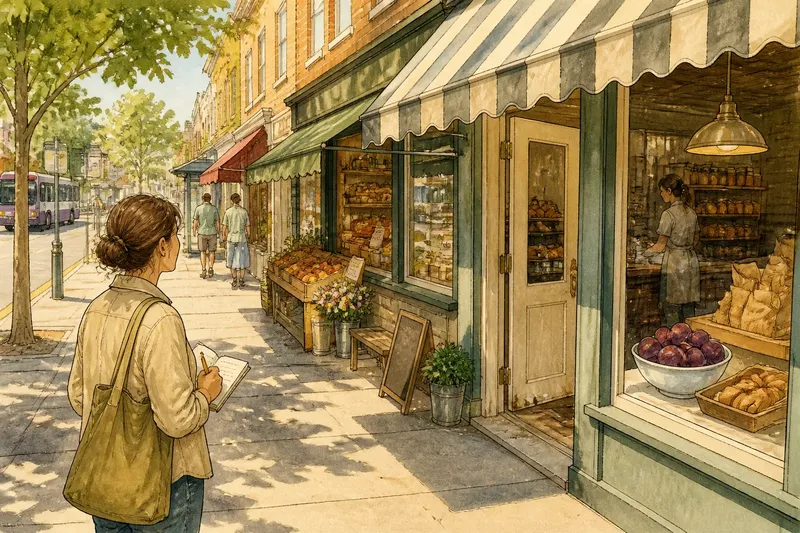
The common mistake on a late-summer neighborhood walk is to hurry past the storefronts on the way to somewhere else. That costs you the small changes that make a familiar block feel different: an awning’s shade reaching farther across the sidewalk, a display rearranged for the season, or a door propped open while the afternoon is still warm. A late-summer neighborhood walk can make those details easy to notice without asking you to buy anything.
Imagine that Mara, who lives a few blocks from a row of independent shops, chooses a quiet afternoon for a walk. She plans to observe how shade, displays, and open doors shape the street as summer begins to soften. Her route, notes, and pauses are invented, but the method is useful: move at an unhurried pace, look closely, and treat each shopfront as part of a changing public scene rather than an invitation to spend.
How can you choose a route that rewards looking?
Mara starts with one compact stretch she already knows, rather than trying to cover the whole neighborhood. She picks a route with a mix of storefronts: perhaps a bakery, a repair shop, a small grocer, a florist, or a café. The point is not to collect a representative sample. It is to give her eyes enough time to notice differences between places that face the same weather and street.
She chooses a starting point with a clear view of the block and walks toward a simple landmark at the other end, such as a library entrance or a bus stop. That gives the walk a shape without making it a timed errand. If the route loops back, she can see how the light has shifted on the return; if it ends at a transit stop, she can head home without retracing every step.
Before setting out, Mara checks the weather and chooses comfortable shoes. She brings a small notebook and pencil, but leaves the camera in her bag at first. Writing a phrase such as “striped awning cuts the glare” is often enough. A camera can help when she wants to remember a visual detail, but it can also make a casual observer feel as though every window must become a photograph. The walk works just as well with nothing to carry.
It is not worth the effort to build a route around every shop, chase a particular light effect, or make a detailed map before leaving. Those tasks can turn noticing into a project. One short block and a little patience are enough to reveal how storefronts differ.
What does the shade tell you about the sidewalk?
At the first shop, Mara looks at the edge of the awning rather than only at the sign or window. Does its shadow cover the glass, the entrance, a small patch of pavement, or none of those? Does the shade make a place to pause, or does it leave the walking path clear? She is not judging whether the awning is good or bad. She is noticing how it changes the space shared by shop visitors and passersby.
As the afternoon advances, the pattern of shade can shift. A canvas canopy may shelter a display while leaving the doorway bright. A tree across the street may throw broken shade over a painted sign. A recessed entrance may stay cool even when the storefront beside it is exposed. These differences give Mara clues about the street’s feel without requiring her to enter any shop.
She also notices how people respond. Someone may slow down beneath an awning to read a menu; another person may keep moving where the pavement is sunny. A delivery worker might choose the shaded side of a doorway while checking a list. These are passing observations, not a reason to watch anyone closely. Mara keeps her attention on the arrangement of shade and movement, and gives people their privacy.
When she writes notes, she records what she can see: “the shadow reaches the bench,” or “the awning covers the window but not the door.” She avoids guessing why a business chose a particular fabric or whether a display is intended to draw people inside. A storefront may reflect practical needs, a landlord’s rules, a shopkeeper’s preference, or some mix of them; the walk can describe the result without claiming to know the explanation.
How do late-summer displays change the street?
At the next window, Mara looks for the way objects are arranged, not simply for what is on sale. A grocer might place peaches beside a handwritten note. A bookshop might turn a few covers toward the glass. A tailor might display a linen jacket in the brightest part of the window. Those details can make a block feel seasonal even when the buildings and businesses have not changed.
Late summer often brings a subtle transition in what a display suggests. A window can hold bright colors and warm-weather goods while introducing school supplies, sturdier fabrics, or a darker palette. Mara looks for the overlap rather than treating the season as a sharp dividing line. A straw hat beside a wool scarf, for instance, could make the window feel like a record of changing weather rather than a fully switched-over scene.
She also notices the display’s relationship to the sidewalk. Is it set low enough to be seen by a child? Does a bright object catch the eye from across the street? Is the glass crowded, or does it leave a clear view into the shop? Mara does not need to decide which arrangement is most appealing. She can describe how it meets the street and what it invites a passerby to notice.
Say Mara reaches a fictional corner bakery with a window showing a bowl of late-season plums beside a tray of paper-wrapped lunch rolls. She notes that the fruit’s deep color stands out against a pale cloth, while the rolls sit closer to the door. Then she steps back to see how the display reads from the far curb. The expected result is a more useful observation than “nice window”: she can remember which details caught her eye and how distance changed the view, without entering or purchasing anything.
For a fair comparison, Mara does not rank one shop against another. A sparse window may suit a repair business, while a dense arrangement may be part of a grocer’s everyday work. The interesting question is how each place makes its purpose visible from the sidewalk, and how that appearance changes as the season turns.
What can an open door reveal without an invitation?
An open door changes the boundary between shop and street. Sound may carry out: a bell, conversation, a radio, or the soft clatter of work. A smell might drift toward the curb. A person standing just inside may be visible from the pavement. Mara observes these cues from outside and does not treat an open entrance as permission to enter.
She notices whether the door is wide open, held by a wedge, or opening and closing as people come and go. There may be a practical reason: bringing in stock, airing the room, or letting the day’s warmth circulate. She cannot know the reason by looking, so she records the visible detail rather than assigning one. The useful point is how the opening changes the shopfront’s feel: a sealed window may read as quiet, while an open doorway can make the business seem more connected to the sidewalk.
That connection is not always an invitation to linger. A clear entrance needs room for people to pass, and a shop’s threshold belongs to its customers and workers. Mara keeps out of the doorway, avoids photographing people without permission, and moves along if someone is carrying goods or trying to enter. Respectful distance helps the walk stay observational rather than intrusive.
What questions help you read a changing shopfront?
What should you write down on a neighborhood walk?
Note visible details such as the direction of an awning’s shadow, the objects placed nearest the glass, or whether the door is open. Short descriptions are easier to compare later than broad judgments about whether a shop looks inviting.
When is the best time for a late-summer walk?
Choose a time when you can comfortably walk and the street is active enough for ordinary movement. The light and temperature vary by block and day, so a flexible afternoon plan is more useful than chasing a supposedly perfect hour.
Can you take photos of shopfronts?
You can photograph architectural details where doing so is allowed, but be mindful of people, private interiors, and signs asking visitors not to take pictures. If a person becomes the main subject or you want to capture a worker at close range, ask permission or keep the camera away.
How can you observe without feeling pressured to buy?
Choose a route that is a walk rather than a shopping errand, and let notes or a quiet pause be the purpose of each stop. If a shopkeeper speaks to you, a friendly greeting and an honest reply are enough; you do not need to invent a reason to enter.
How does Mara bring the walk to a close?
At the end of the block, Mara sits on a public bench and looks over her brief notes. She has recorded three different kinds of shade, several displays that hold both summer and early-fall cues, and two open doors that changed the sound or feel of the sidewalk. She has not decided which shop is best, and she has not tried to infer what its owners think. Her result is a clearer picture of how the street presents itself during a particular stretch of the season.
On the return walk, she notices whether the same storefronts look different from the opposite direction. A display that seemed quiet from close up may catch the eye across the street; a patch of shade may now fall over the entrance instead of the window. Mara adds one final note about what changed with the viewpoint. That small comparison makes the walk more attentive without extending it into an assignment.
A late-summer neighborhood walk is most useful when its notes remain modest: what the light covered, what the window showed, and what crossed the threshold into the street. Keep the description concrete and the interpretation open. The next time you pass the same block, you may notice that the shopfronts have changed again—and you will have a clearer sense of what to look for.