Open House or Hosted Walk: Two Ways to Welcome Neighbours
Open house or hosted walk? Choose a gathering format that fits your space, pace, accessibility needs, and the kind of neighborly conversation you hope to invite.
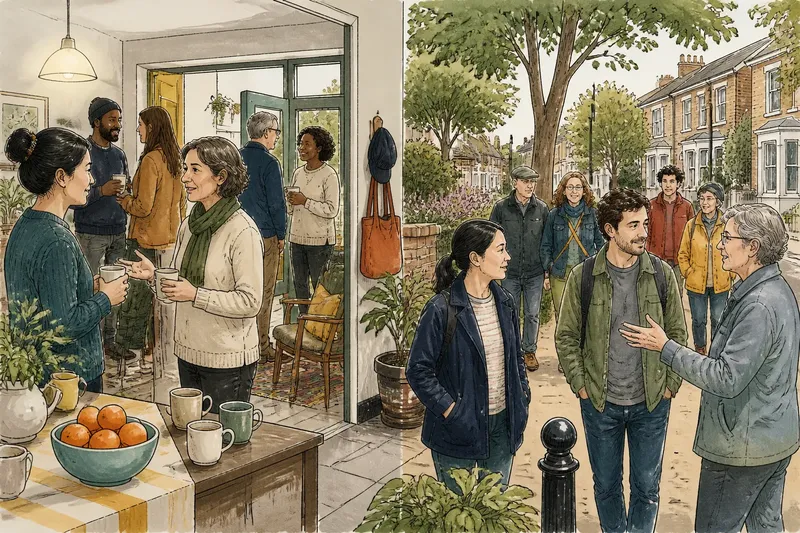
The common mistake with an open house or hosted neighborhood walk is choosing the format before picturing how guests will actually spend their time. A living room can feel crowded when arrivals bunch up; a walk can leave quiet neighbors behind if the route moves too quickly. Match the gathering to the kind of conversation you want, and the welcome feels easier for everyone.
What does an open house make easier?
An open house gives people room to arrive on their own schedule. Guests can stay for a short hello or settle in for a longer chat, which suits neighbors juggling errands, family routines, or uneven work hours. The host does not need to keep a group moving or deliver a running commentary.
That freedom changes the conversation. People tend to form small clusters around a snack table, a window, or a shared interest. A newcomer can join quietly, listen for a moment, and find an opening without addressing the whole group.
The trade-off is that some guests may never meet. If the gathering is in a home or shared courtyard, a clear landing spot helps: a table with tea, a bowl of clementines, or a simple note showing where coats can go. Keep the room layout open enough for people to move around without squeezing past furniture.
When does a hosted walk feel more natural?
A neighborhood walk gives the gathering a shared pace and a reason to look outward. A host can point out a useful shortcut, a shaded bench, or a storefront whose owner welcomes a quick greeting. Conversation often grows from what the group sees rather than from the pressure to make small talk in a room.
Movement can also make introductions less intense. People walk beside one another instead of facing a circle, and a pause at a corner gives the group an easy reset. For a small community gathering, that can help neighbors who are more comfortable talking while doing something together.
The route needs a little thought. Choose a loop with places to pause, avoid relying on private property, and leave room for different walking speeds. A walk is less suitable if the route is noisy, difficult to cross, or uncomfortable for someone using a mobility aid. A short, accessible path with a comfortable stopping point is more welcoming than a long itinerary of local sights.
How do you choose between an open house and a hosted walk?
Start with the gathering’s purpose, then consider the setting and the guests. An open house works well when flexible arrival matters and there is a comfortable place to linger. A hosted walk works well when the neighborhood itself provides natural conversation and the group can move at an inclusive pace.
- Choose an open house if guests may arrive at different times or need to leave early.
- Choose a hosted walk if a shared route can give newcomers something easy to talk about.
- Think about access before settling on either format: consider seating, indoor comfort, route surfaces, crossings, and rest points.
- Keep the group small enough to hear one another. If the invitation list grows, consider splitting a walk into smaller groups or making the open house a drop-in gathering.
- Plan a gentle entry. At home, greet people near the door; on a walk, name the route and the first stopping place before setting off.
Say you want to welcome several new tenants in a block where people keep different hours. You might host an open house in a shared lounge, set out tea, and invite guests to drop in during a broad window. The expected result is a relaxed mix of brief introductions and longer chats, without requiring anyone to join a group at one fixed departure time.
What small details shape the pace?
For an open house, the host’s movement matters. Avoid getting locked into kitchen duty; put out food that can sit comfortably and label anything that needs explanation. A few chairs in pairs often invite conversation more readily than a single formal circle. If the space is shared, make it clear which areas are part of the gathering and which are private.
For a walk, tell guests where to meet, how long the route is expected to feel, and whether there will be a place to sit. You do not need a speech at every stop. A simple prompt such as “Where do you usually pick up bread?” can open a useful exchange without turning the outing into a tour.
What is not worth the effort? Elaborate refreshments, printed itineraries, or a packed sequence of stops. A gathering does not need to perform local expertise; it needs a comfortable reason for neighbors to be together.
Which format fits these common situations?
Can an open house work if people do not know one another?
Yes, if there is an easy place to begin, such as a shared table or a host who introduces arriving guests. Keep the invitation low-pressure so people can listen before joining a conversation.
Is a hosted walk a good choice for a mixed-age group?
It can be, provided the route has a manageable pace, safe crossings, and places to pause. If those conditions are uncertain, an indoor gathering with seating may be the kinder option.
How can a host avoid dominating the conversation?
Offer a brief welcome and let guests take the lead. On a walk, use occasional prompts rather than narrating every block; at an open house, make introductions and then step back.
Can the two formats be combined?
Yes: meet for a short neighborhood loop, then invite anyone who wishes to stay for tea. Make the indoor portion optional, so the walk does not become a requirement for joining the gathering.
What should the invitation make clear?
State the format plainly, along with the meeting point or entrance, the approximate pace, and whether guests can arrive late or leave early. Mention seating or route access where it will help someone decide comfortably. When a venue, route, or shared space has specific access rules, check the relevant guidance before sending the invitation.
For an open house, describe it as a drop-in if that is what you mean; for a walk, say whether the group will return to its starting point. Those small details let neighbors choose the kind of participation that suits them. The best open house or hosted walk is not the one with the fullest schedule, but the one whose pace leaves people room to feel they belong.