Why a Street Corner Becomes a Local Landmark
Why a street corner becomes a local landmark: learn to spot the useful position, memorable shape, and repeated encounters that make directions stick.
The common mistake is to assume a local landmark needs a grand building, a plaque, or a famous story. That can cost a neighborhood a simple, useful reference point: the corner people already pass, recognize, and use to explain where to meet. A street corner becomes a local landmark through small, repeated encounters, not an official designation.
If you want to notice how that happens on your own block, start with its routes and routines. Look for the corner people naturally point out, then pay attention to what makes it easy to remember and say aloud. The aim is to understand a piece of local shorthand, not to turn an ordinary place into a formal attraction.
Which corner do people already use as a reference?
Begin by walking the streets at ordinary times: on a weekday morning, during the school run, or as nearby shops close. You are looking for a junction that already helps people orient themselves. Perhaps a bus stop sits beside it, a path cuts through a small green, or two well-used streets meet there. The useful position often matters more than a striking appearance.
Notice how people move rather than trying to collect opinions. Do pedestrians pause at the crossing? Do neighbors turn there to reach a corner store, a library, or an apartment entrance? Does someone use the junction to explain where a delivery should go? Those everyday actions reveal whether the place belongs to a shared mental map.
Keep the observation respectful and low-key. You do not need to follow anyone, record faces, or ask strangers to identify themselves. A pocket notebook can hold brief, general observations: “path meets bus stop,” “people wait near the mural,” or “shop entrance faces the cross street.” This is enough to help you compare corners without treating residents as research subjects.
Also notice who might find the corner hard to use. A landmark that is obvious to someone walking may be less helpful to a person arriving by bus, using a mobility aid, or looking for a building from the opposite direction. A good local reference should make sense from more than one approach, even if it is not equally visible from every route.
What makes its position genuinely useful?
A corner becomes a practical reference when it sits at a decision point. Someone approaching it may need to choose between two streets, turn toward a transit stop, or find a familiar entrance. A place passed on the way to somewhere else can become easier to explain than a destination tucked halfway down a block.
Trace the approaches in both directions. From each side, ask what comes into view first and what the next choice is. A corner near a grocery entrance might be helpful for a short errand, while a junction beside a school crossing may anchor directions across several blocks. Consider whether the reference works for a person who is walking toward it and for one who has just passed it.
Then check whether the spot is usable as a meeting point or merely easy to describe. A narrow sidewalk, a busy driveway, or a doorway that needs to stay clear can make “meet at the corner” awkward. If people need to wait, look for a nearby public edge with room to stand without blocking pedestrians or entering private property. The landmark can be the junction while the meeting place is a few steps away.
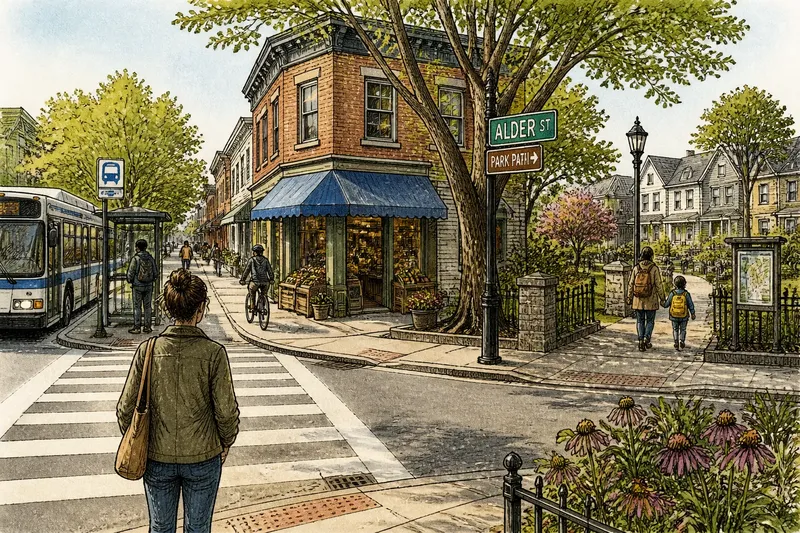
Say you notice that people often mention the corner where Alder Street meets the path to a small park, but the pavement there is too narrow for a comfortable wait. You could describe the reference as the path junction and suggest meeting on the park-side sidewalk, away from the entrance. The expected observable result is clearer directions and less crowding at the tight corner, without claiming the junction as an official venue.
Which visual detail makes the corner stick?
Once you have a useful position, look for a feature that distinguishes it from the next intersection. It might be the clipped angle of a brick storefront, a mature tree visible above a low fence, a painted wall, or the way a side street opens toward a row of houses. The best cue is often something already present and easy to describe.
Try describing the corner in one plain sentence. “The junction by the blue awning” gives a clear visual cue if that awning is visible from the route. “The historic corner” says less unless people share a reason for calling it historic. Prefer a detail that can be checked from the sidewalk rather than a private nickname that newcomers cannot decode.
A useful cue should survive a change in viewpoint. A sign partly hidden behind a tree may work from one approach but disappear from another. A distinctive roofline or broad mural might remain visible farther away. At night, a feature that depends on color alone may be difficult to pick out, so consider shape, placement, and surrounding landmarks too.
There is no need to add a decorative marker or ask a business to change its frontage. A new object can create maintenance, permission, and accessibility questions while adding little to a corner people already recognize. It is not worth the effort to manufacture a landmark when a dependable visual feature is already doing the job.
How do repeated encounters create shared meaning?
Recognition grows as people encounter the same place in different routines. A parent may pass it on the school route, a neighbor may wait there for a bus, and a shop worker may cross it on the way to open up. These are separate experiences, but the corner becomes easier to refer to when the same cue appears again and again.
Listen for the words people use naturally. A junction can acquire a familiar description because residents say “by the mural” or “where the path starts,” not because anyone announced a name. If you are talking with neighbors, ask an open question such as, “What do you call this corner when giving directions?” Accept that different people may use different names; local shorthand does not have to be uniform.
Try the description with someone who does not use that route every day. If it leads them toward the correct intersection, the reference is doing useful work. If they confuse it with another corner, add a second public cue, such as the cross street or nearby bus stop. Keep the wording short enough to use in a message or a quick conversation.
A corner’s character can also come from what happens around it without becoming a destination in its own right. A small produce stand, a regular school crossing, or a neighbor who pauses to chat may help make the place familiar. Describe those routines with care: people’s habits belong to them, and a landmark is not permission to turn someone’s daily life into a spectacle.
How can you tell the reference is working?
Check whether the corner helps with real, ordinary directions. Does a newcomer find the right turn? Can someone give a concise description without listing several uncertain landmarks? Do residents recognize the phrase, even if they add their own variation? These modest signs matter more than whether a place appears on a map as a named point of interest.
Notice the limits, too. A corner may be well known on one side of the neighborhood but unfamiliar a few blocks away. A shop can change hands, a tree can be removed, or construction can obscure a mural. If the most memorable feature changes, update the description rather than insisting that the old reference still makes sense.
Keep a simple note of the corner’s position, its visible cue, and the routes that make it useful. A short description such as “east entrance to the footpath at Alder and Pine” is more durable than a long story that depends on one person being present. Share it only where it helps someone find a place, and avoid adding personal details about people who gather nearby.
What questions come up about local landmarks?
Does a street corner need an official name?
No. A corner can work as a local landmark through a shared description, even if it has no formal sign or mapped label. If you are unsure about naming, signs, or public use, follow the relevant local rules and ask the appropriate municipal office.
What if neighbors call the same corner by different names?
Keep the descriptions that are clear and useful rather than trying to enforce one approved phrase. Adding the cross streets or a visible feature can bridge differences and help someone unfamiliar with the local shorthand.
Can a landmark change when a shop or building changes?
Yes. If the reference depends on a business awning or a particular storefront, its usefulness may fade when that feature changes. Recheck the corner from its usual approaches and shift to a more stable public cue if one is available.
How is a local landmark different from an attraction?
A landmark helps people recognize a place or give directions; an attraction invites people to visit for its own sake. A neighborhood corner can be meaningful and useful without needing promotion, programming, or a visitor-facing identity.
When you are trying to understand why a street corner becomes a local landmark, focus on the link between where it sits, what people can recognize, and how often their routes bring them back. A clear description can help someone find the right turn while leaving the corner to remain what it is: part of the neighborhood’s everyday life.