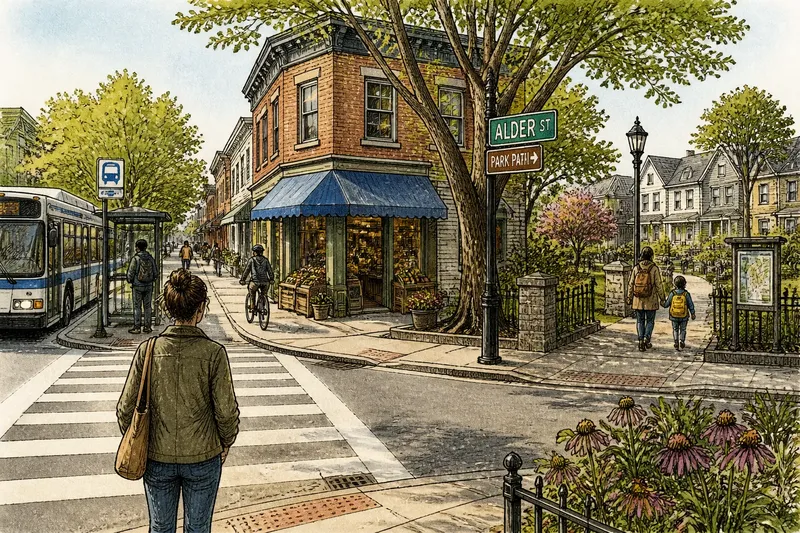
The Noticeboard Before the Group Chat
A local noticeboard shows who needs to hear what, where neighbors pause, and how shared information can reach beyond the group chat.
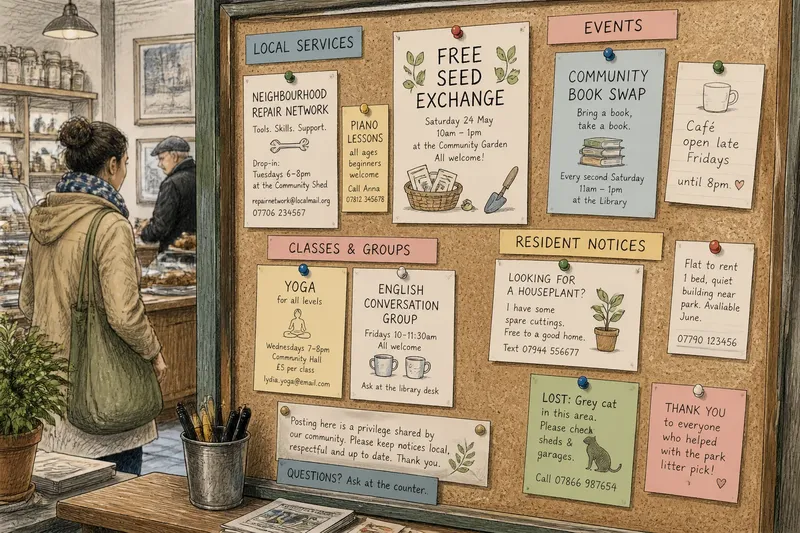
The common mistake with a local noticeboard is to treat it as a wall that happens to collect paper. That misses what its placement and arrangement cost people who cannot use a neighborhood chat: they may walk past the only visible route to a class, a repair service, or a change in a shared space without realizing it is there. A noticeboard before the group chat was a local information point, but it still depended on someone choosing a place, tending the surface, and making information legible.
Look closely at a board in a library, laundromat, corner store, apartment entry, or community hall. The surrounding activity tells you who is likely to see it. The order of papers suggests which messages are current, useful, or simply persistent. A board is not a complete record of neighborhood life; it is a small map of how information is allowed to travel through a shared place.
What can a noticeboard tell you at a glance?
Start with the board’s location, not its flyers. A notice at an entrance reaches people as they arrive or leave. One beside a counter may be seen while someone waits to pay. A board in a hallway can serve residents who pass through daily, while a board tucked behind a door may be technically public but easy to miss.
Placement also hints at the audience the host has in mind. A library board can gather announcements for people who come to borrow books, use a public computer, or attend a program. A board inside a neighborhood café may be shaped by regular customers and the staff who decide what fits. Neither is automatically a full picture of the surrounding area.
Then notice the physical arrangement. Are papers grouped by topic, pinned in a rough chronology, or layered over one another? Are large, easy-to-read notices placed at eye level, or are they buried under smaller sheets? Even without knowing who posted each item, you can see which kinds of messages have room to remain visible.
Which kind of shared place fits the message?
For information meant for people already using a service, place it where those people naturally stop. A community center can suit a class announcement; a laundromat may suit a neighborhood clothing swap; a shop counter may suit a note about altered opening arrangements. The useful question is not “Where can this be pinned?” but “Who is already here, and do they have a moment to read?”
For a message meant to cross social circles, consider a place with varied everyday visitors, such as a public library or a busy community hall. A board in a single building can be more relevant to its residents than a central location, though it will not reach neighbors who rarely enter. No one placement reaches everyone, so a host may choose a second appropriate board rather than crowding one surface with every kind of announcement.
Say a fictional neighborhood group wants to invite residents to a free seed exchange. If the event is tied to a shared garden, a board at the garden gate can reach people already interested in that space. If the group also wants passersby who do not garden to know about it, a second notice at the library can widen the route; the visible result would be two clear invitations in places with different audiences, not a claim that every neighbor has been reached.
How should the information be arranged?
A board works best when a passerby can tell quickly what a notice is about, who it concerns, and what to do next. A readable heading, a concise explanation, and a clear contact method help. For a paper announcement, the most relevant details should be visible without requiring someone to pull it down or photograph a crowded corner.
Grouping by purpose can make a busy board easier to scan. For instance, a host might keep local services together, put events in a separate area, and leave a clearly marked space for resident notices. The exact categories should reflect the place. A small building lobby may need only a few broad groupings, while a library board can accommodate a wider mix.
- Keep headings large enough to distinguish from body text.
- Leave space between unrelated notices so their edges and messages remain clear.
- Put time-sensitive information where it is easy to spot, then remove it when it no longer applies.
- Use a consistent area for recurring kinds of announcements.
- Make the posting contact or host visible, so people know whom to ask about the board.
- Keep essential details on the notice itself rather than relying on a link or a code alone.
Uniform design is not the goal. A hand-lettered class announcement can sit beside a neatly printed community calendar, and the difference may reflect the resources of the people posting. What matters is whether the reader can distinguish one message from another and understand how to respond.
Who maintains the board, and what should they decide?
Every public-facing board has an informal editor, even if no one uses that title. It may be a librarian, a building manager, a shop owner, a volunteer, or a small group that takes turns. Someone decides what can be posted, whether a notice stays up, and how much space a message can occupy. Those decisions shape the board as much as the flyers do.
A simple, visible posting policy can make that role fairer. It might state who may post, which kinds of messages belong, how to request space, and how old items are handled. A clear process helps prevent the board from becoming a private pin-up area for one organization or a place where neighbors cannot tell whether a notice is current.
Maintenance need not mean polishing away every trace of use. A board that looks active can invite contributions, but a thick layer of curled paper can make it hard to read and suggest that no one is tending it. The practical balance is to preserve useful local messages while removing stale ones and making room for new voices.
What are people usually trying to find?
Where should a neighborhood noticeboard go?
Choose a place people enter or pause in during ordinary routines, with the host’s permission and a clear view of the board. Match the location to the intended audience rather than assuming the busiest wall is the most useful one.
What belongs on a community noticeboard?
Local events, services, classes, mutual-aid requests, and practical updates can fit when they serve people connected to the place. A short posting policy helps readers understand why some messages appear and others do not.
How often should old notices be removed?
Review the board often enough that expired invitations and outdated updates do not crowd out current information. A host can set a regular review rhythm that suits how quickly the notices change, without treating every paper as disposable.
Can a noticeboard still help when neighbors use group chats?
Yes, because a board can reach people who are not in a particular chat, do not check it, or prefer to read information in the place where it matters. It can also make local messages visible to someone who did not know to search for them online.
When is a board better than a group chat?
A group chat is useful for quick exchanges among people who have joined it. A public board is better suited to messages that should be encountered without an invitation to a digital group: a recurring class, a local service, a notice for visitors, or an announcement aimed at people who share a building or facility. The board’s strength is its physical presence, not speed.
That presence has limits. A flyer cannot answer a follow-up question in real time, and a board may not be visible to someone who does not pass through the host location. For an urgent update, the board alone may be too slow; for an announcement that should remain findable in a familiar place, it can be a useful companion to other channels.
It is not worth the effort to make every notice look alike or to build an elaborate classification system for a small board. If readers can find the main information and the host can maintain the arrangement, simple labels and a little open space are enough. The board should serve the life of the place, not become a project that demands more attention than its messages.
What does the board leave out?
A noticeboard records what people choose to post and what its host permits, not every need or opinion in the neighborhood. A quiet board may reflect a hard-to-find location, unclear rules, or a lack of time to contribute; it does not prove that residents have nothing to say. A crowded board can suggest active use while still favoring people who already know how to post there.
That is why placement and arrangement matter together. A welcoming location without space for different kinds of messages can still feel closed. A well-organized board in a hidden corridor may be easy to read but difficult to discover. The most useful question for a passerby or host is whether a person who is new to this place can identify what the board offers and how to take part.
Read a local noticeboard as a small piece of neighborhood infrastructure: notice who can encounter it, how messages are sorted, and whether the next action is clear. That gives the phrase “noticeboard before the group chat” a practical meaning. The board is not an old-fashioned substitute for every conversation; it is a visible invitation to information that belongs in a shared place.